

Designing an Economy That Works for Life
We face a peculiar inversion: rather than the economy serving our needs, we have become servants to the economic growth model. Beneath our suits and dresses, we remain organisms requiring food, shelter and connection. What we excrete feeds natural cycles. This straightforward observation opens a different lens on what an economy could be.
Césare Peeren
Architecture | Sustainability | EntrepreneurConsider a tree. Its leaf patterns and branching structure are optimized for water flow and solar energy absorption. It breathes, purifies, produces oxygen. No waste, no inefficiency; only function within an eternal material cycle. Or examine Dutch windmills from centuries past: constructed from locally available wood and straw, demountable when needed elsewhere, but crucially; a shared instrument for the surrounding community. They processed locally grown materials for local use. What these examples reveal is not nostalgia but a design logic we have lost sight of.
In the economic model I envision, we no longer waste materials or energy. We become genuinely materialistic; meaning we take complete responsibility for materials throughout their entire lifespan. We use only energy drawn from the immediate, local environment. And we live in contact with nature, other people and animals, where our well-being does not come at their expense. This is not a future fantasy for some distant island. It is achievable here and now, from the world we already know.
The current system wastes materials, food, energy and human lives because the economic model thrives on producing, selling, discarding stuff. This keeps us in a constant state of busyness. Yet this very wastefulness offers the opening for transition. If the system operates so inefficiently, it must be possible to drastically reduce impact while increasing well-being for everyone; by intervening in the waste streams.
Strategy 1: Waste as Transition Opportunity; No More Virgin Mining
After decades of exponential growth, we have extracted, constructed, hoarded and discarded more than ever. Cupboards, backyards, storage sheds, landfills and oceans overflow with electronics, furniture, clothing, white goods, washing machines, solar panels, wind turbine blades, bicycles, cars, airplanes; materials from every technological and fashion era.
This abundance of existing materials can be deployed to transform toward a different system, based on (re)using, regenerating, renovating and (re)creating. Products based on what we need that can last for generations; becoming more beautiful and valuable with each repair and renewed life.
Globally, an enormous stock of old and new buildings stands empty or underused: homes, offices, schools, museums, churches, factories, villages, entire cities. The empty ones can be used as donor buildings or restored and adapted, in function and energy, with waste materials. Most other buildings are not used all week and only 8 hours a day, reorganizing the use of buildings, can increase the use per week. Those two strategies combined can decrease our need for new buildings to zero.
Since 1997, Superuse has demonstrated through more than one hundred projects that this is feasible. From lamps and art installations to shops and restaurants, playgrounds, museums, homes, social housing and a complete village; built and renovated with at least 80% reused materials. We apply reclaimed materials in ways that replace the need for virgin resources. Toilets from old water tanks, easily hosed clean.
Concert halls acoustically enhanced with reclaimed aircraft interiors. Playgrounds from wind turbine blades where children play in and on them; blades that now function longer as play equipment than they did producing energy. At Boschgaard, we reused a vacant 1970s community center, restored its neighborhood function and added 19 social housing units with a wooden structure harvested from a demolished petrol station and a library, reclaimed structural insulation panels for facades and roofs, and laser-cut metal waste for vertical gardens and shading.
Using waste requires a different design approach. You must ‘listen to the materials,’ which means first knowing what is available at the moment of execution and choosing from that. You must understand the material’s characteristics so design and material find each other. This inverts the normal design sequence: first understand what you can work with, then design. To reduce transport energy, Superuse designs with waste materials sourced as locally as possible.
We design products and buildings to last generations, becoming better and more beautiful year after year, a cyclical or ‘cascading’ system. This entails first determining whether we can improve what already exists. Everything we must replace finds another destination for reuse, each time in a new, appropriate form. This is called ‘cascading’: materials create value repeatedly in different lives.
Rather than extracting virgin materials from mines, we can mine our urban environment for discarded materials. Waste materials from the oil era play a crucial role: they provide time to grow locally sourced biobased materials necessary for continued maintenance of our homes. Long-term, biobased materials will ensure healthier living environments in buildings as current toxins phase out and our buildings achieve healthy, natural indoor climates.
Strategy 2: Bioclimatic Architecture
Buildings can heat and ventilate themselves with minimal energy and technology. Vernacular architecture shows numerous examples. Persian cooling towers that cool desert cities and Inuit igloos, both created comfort in extreme climates without machines. Termites build passively climatized cities worldwide, creating ideal indoor climates for living and food cultivation in symbiotic relationships with fungi. Though termites outweigh humans in total mass, they only enrich planetary ecosystems.
Our cities devour energy in inconceivable quantities, we are discussing terawatt-hours. The average person today uses 250 times more energy to eat, work and relax than their supposedly less efficient primitive forebears. Approximately half the building budget now goes to sustainable climate systems and the renewable energy to power them.
Yet we can create cities that ventilate and heat themselves with sun, wind and geothermal energy; without intervention from energy-devouring machines by designing buildings themselves as climate machines. Superuse on site has experimented with passive heating, cooling, lighting and ventilating since 2015.
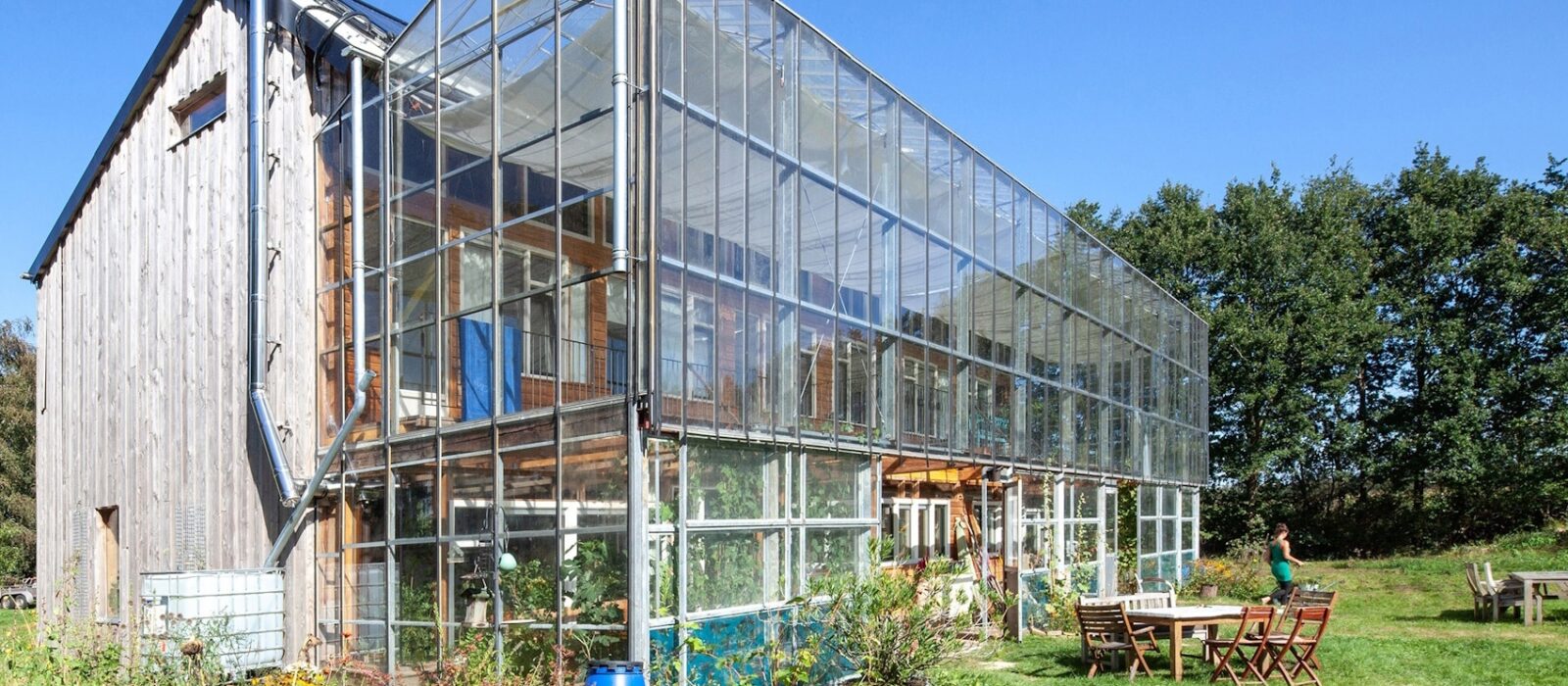
In the Green House project, we designed a four-unit terraced house. North, east and west facades breathe and are exceptionally well insulated with locally harvested straw bales. The south-facing facade with greenhouse regulates ventilation and heating year-round. In midwinter, a mass heater provides additional heating if needed, burning wood from the property’s own land.
At Boschgaard, substantial heat comes from conservatories, supplemented by PV panels supplying electricity for boilers and three heat pumps extracting heat from the ground in winter and returning it in summer. Here, regulations required us to use considerably more technology than we considered necessary.
In a small house currently under construction at the Land van Aine eco-village, where we can experiment outside building regulations, we can advance much further with passive heating and ventilation. This house has a very small core to heat and minimizes heat loss through its round shape. Moreover, that core is completely surrounded by buffer spaces: a conservatory facing south around the core, unheated bedrooms east and west, storage spaces on the north side. This allows the living space to be heated entirely from solar energy naturally harvested from the conservatory. External shutters close at night but can also automatically open and close when the occupant is away, offering the choice to actively harvest solar heat or retain it inside. The house ventilates through an underground pipe bringing earth-cooled air in summer and earth-warmed air in winter. A small rocket stove (a super-efficient stove that also burns smoke to extract all heat energy from wood) can be used in midwinter for cooking while simultaneously adding heat to the thermal mass seat and floor.
Even in the challenging Dutch climate, a home can function entirely naturally and comfortably. Regulations and current building practices pose challenges, but with cooperation and flexibility in legislation, it is possible to realize a new generation of buildings: natural, energy-efficient and comfortable, without compromising daily life.
Strategy 3: Re-localizing
Though it may require considerable change in habits: if we organize cities so we can find everything we need within the neighborhood where we live, and if we produce, repair and reuse the vast majority of what we need within that city, we gain substantially in freed time, space, resource efficiency and energy; ultimately, improved quality of life.
Superuse’s office in Rotterdam is located in Blue City, a former tropical indoor swimming pool complex. All companies within Blue City process local waste streams into new products. Superuse creates a ‘harvest map’ for each design and architecture project showing what waste is locally available and thus usable for the project. Other Blue City companies process bread waste into beer, used coffee grounds into oyster mushrooms, decommissioned solar panels into new solar panels, fruit waste into vegan leather, and so on.
The first step as described in the first two strageges is reducing the need. The need for new buildings and products by extending lifecycles, repairing and reusing.This lowers resource requirements. By sourcing as many materials as possible from our urban ecosystem, we can also produce most things at small scale, creating industries within our cities. We become less reliant on the global system and gain more control over the quality of our goods and working conditions.
If we could meet most needs within walking or cycling distance, a large portion of public space currently used for cars and parking would become available for food production, social activities and greening for biodiversity. The Aztecs built large cities in South America where the entire food supply for approximately one million inhabitants formed an integral part of the city. As a consequence of the Cuban oil embargo, Havana provided 60% of its inhabitants’ fresh vegetable needs by applying permaculture principles within the city.
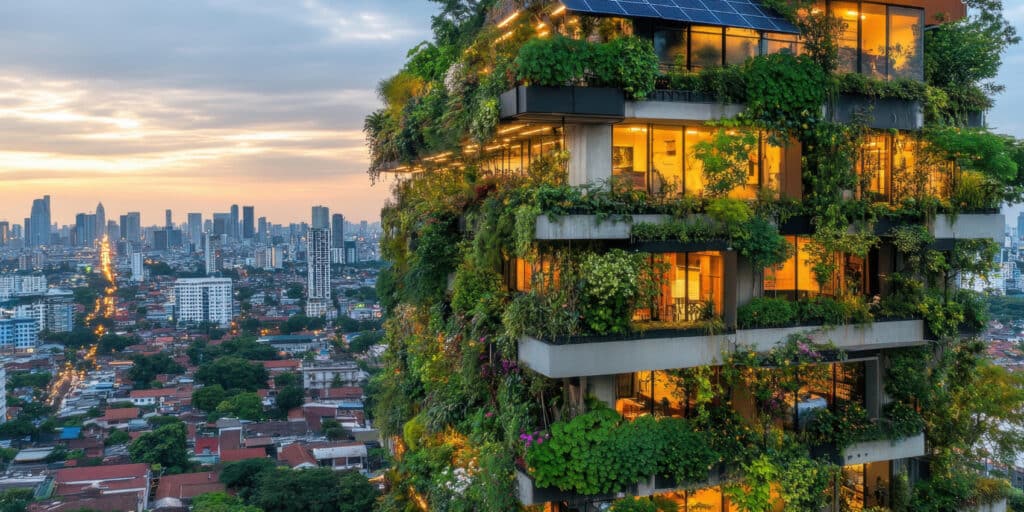
An entire network of street gardens, roof gardens, vertical farms, greenhouses attached to buildings, neighborhood gardens, aquaponics systems in old garages, food forests in parks (supplemented by necessary hectares of professional agriculture just outside the city), makes this vision conceivable. Depending on the scale of various urban areas: people work on their own food supply, share work with other keen gardeners, or hire a professional farmer for their courtyard, or a local farmer supplies their local market. This offers opportunities to reuse all organic waste locally through composting. Because the green environment also buffers rainwater and human waste is no longer flushed away with drinking water, no water is wasted.
Rather than depending on global chains, we can produce most of our food and most other products locally and regeneratively. This makes cities not only greener and healthier but also more resilient.
Strategy 4: Rebuilding Commons
To become less dependent on the financial system and global chains, we as humans have several basic needs that must be met: food, comfort and certainty that this remains so as we age and become dependent. We have outsourced all these matters to the ‘system’ through loans, pensions and insurance. Would it not be safer to resolve this with the people we love most and trust? This is how most of human existence has functioned. Food literally grew on trees and shelter was not an investment product. Humans had common access to resources, food, goods, knowledge and care. It is time to reclaim the commons and build a robust local economy.
This works best when we collaborate, becoming community-sufficient. This is why we also propose building communities—which can take many forms and involve varying degrees of cooperation. The idea is to share things with each other and build a social network based on trust. This returns not only responsibility but also control over our lives. It inverts the power pyramid.
During construction of the Green House project, a bakery, food garden and guest accommodation were established to feed and house the many volunteers who came to help build. The idea that this would have lasting function for neighbors in the area did not succeed because population density proved too low and distances too great in the farming district; this would work better in a city.
In addition to housing and shared kitchens, the Boschgaard social housing complex also has a shared workshop, café, flexible office and food gardens across the building roofs and facades. Transfarmers, an organization established by inhabitants, crowdfunded one hectare adjacent to the community and uses it as a local farm, holiday camp and nature education for the neighborhood. A large proportion of residents also work at Boschgaard with local residents on repairs, furniture making, social projects and food production.
For the current fifty residents of the Land van Aine eco-village, we developed a plan to convert their old potato flour factory and surrounding 9 hectares into a together-sufficient community for one hundred residents and fifty guests. Residents grow their own food and are gradually building all communal facilities for this multi-generational village.
The ResourceStation developed by Superuse for the Afrikaander neighborhood converts waste from the weekly market into usable products and meals, using the budget that would otherwise go to waste disposal. An entire cooperative of neighborhood residents has grown around these commons, enabling them to provide food for themselves and many of their neighbors.
What we have observed and learned in all these projects is that this way of life requires far fewer materials and energy because many things and spaces can be shared. Also, provided they have adequate private space and freedom of choice, people derive substantially more satisfaction from their lives. Private spaces can therefore be smaller, but together with shared spaces, each person has much more space at their disposal and the entire complex is considerably more compact.
This strategy reduces dependency of those involved on the current extractive economic system, creating the opportunity to engage in more commons and ultimately transition fully to a post-growth societal organization based on sufficiency and mutual care.
In Conclusion
When you aggregate all strategies and integrate them with each other, a different perspective on the future unfolds. It requires a different approach to designing and developing, beginning with thorough research of the existing situation and dynamics; what we call ‘mapping the flows.’ Only once you have mapped the flows separately; the built environment, waste materials, ecosystems, climate, the human capacity and culture of the site; can you begin designing, ideally in an iterative process together with inhabitants.
The resulting livelihoods closely resemble the concept of ‘blue zones’ where people are known to live to healthy old age. These zones are found at different sites on the planet but share main ingredients: a strong community with ownership, a common purpose, physical exercise as an integrated part of lifestyle, and healthy local and predominantly plant-based food.
An important starting point for people to meet all their needs and facilitate the enormous diversity of individuals is that designs offer diversity in density and desired degree of participation in community versus privacy. There is no single truth and, depending on local circumstances, climate, culture and how the current city is structured, the result of transformation will also differ.
In my vision, this leads to cities with a kaleidoscope of diverse neighborhoods. For example; neighborhoods specializing in energy supply and production of goods, and neighborhoods where more food is grown. Communities have formed around the specialties of different neighborhoods, but everywhere, some food is grown, goods are repaired and life is lived fully. The best and smartest technologies of today merge with ancient knowledge and recent scientific research. Substantially more time is spent together and learning from each other; the worldwide web plays an important role in this—the one it was originally intended for: to share knowledge freely.
The combination of these four strategies would reduce our use of resources and energy to such an extent that we will have more time and space at our disposal. We can focus on the relationships we have with each other, with plants and animals, and with our material possessions. Working and living together in a multi-generational culture, we will have full stewardship of our environment and may have the focus and inclination to think seven generations ahead.
We need not wait. Anyone can begin immediately: consider what happens near you and what of that you can take into your own hands to reduce your waste and costs. Step by step, you can take back ownership of your life.
Césare Peeren
Architecture | Sustainability | EntrepreneurCésare Peeren is a passionate architect, entrepreneur and idealist on a mission to transform...
Request quote View profile