About
Joost Kramer
Where geopolitics and governance intersect, the conversations that truly matter begin.
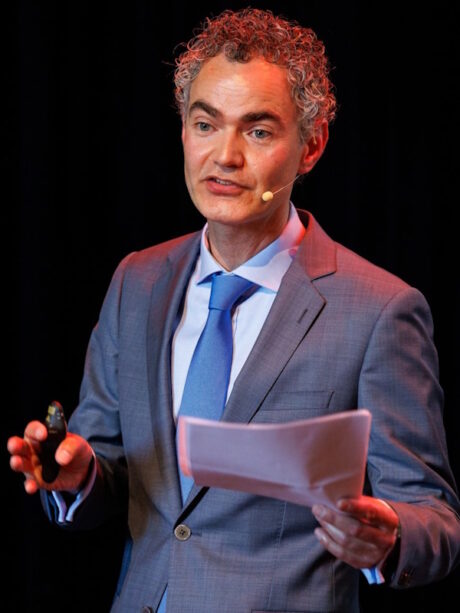
Joost J. Kramer works at the intersection of geopolitics, U.S. politics and corporate governance. He helps organizations understand how international developments — and particularly what happens in the United States — directly influence strategy, oversight and decision-making. His style is calm, analytical and to the point; as a keynote speaker and moderator, he is known for bringing structure, clarity and a natural focus to any discussion.
In his lectures, Joost explains how the global order is shifting, which forces shape American democracy, and how these developments affect companies, public institutions and leaders.
He breaks down the mechanics of elections, institutions, campaigns and the courts, always guided by one central question: what does this mean for leadership, risk and strategic choices in Europe and the Netherlands?
Alongside his speaking work, Joost advises executives and supervisory boards on governance, boardroom dynamics and decision-making under uncertainty. He bridges the ‘outside’ and the ‘inside’: geopolitical pressure points, technological trends, social polarization and regulation on the one hand, and the realities of strategy, oversight, accountability and behaviour on the other. This combination makes his perspective both distinctive and immediately applicable.
Joost’s sessions are marked by clarity, structure and a calm authority. He quickly zooms in on the core of an issue while maintaining the broader context. For business leaders, he explains how external developments — from geopolitical shifts and economic pressure points to technological innovation, social dynamics and evolving regulation — directly shape strategic decisions and governance. For board members and supervisors, he links these trends to concrete governance questions: role clarity, professionalization, risk assessment, strategic agility and societal expectations.
As a moderator, Joost brings composure, sharpness and a touch of humour. He is knowledgeable enough to guide experts, yet modest enough to give others the stage. He structures conversations logically, asks the questions that matter and keeps the pace and tone on track. His presence is often described as analytical, engaging and connecting — a quiet helmsman who is effective both at conferences and in boardrooms.
Joost speaks for organizations seeking to navigate complex change, better interpret what is happening in the world and understand how geopolitics and governance interact. His goal is always the same: to help leaders think more clearly and decide more wisely — especially in turbulent times.
1. U.S. Politics & the Midterms 2026
Joost analyses American politics with a focus on its impact on organizations. In his new book Midterm Mania, he unpacks the logic behind U.S. elections and the dynamics of the 2026 Midterms — how parties shape their strategy, why swing states remain pivotal, and which structural shifts are emerging within the American system. This lecture offers clear context, sharp analysis and directly applicable insights for leaders who want to understand what’s really happening beneath the surface.
American politics continues to shape the global agenda. The 2026 Midterms will again influence the economy, security, regulation and the transatlantic relationship. This session translates geopolitical and market scenarios into tangible risks and opportunities for European and Dutch organizations. The result: clarity in a complex landscape and a sharper view of what decision-makers need to understand to think ahead.
2. A World in Motion: the Role of the U.S. and Its Impact on Europe and Business
In a world where geopolitical balances are shifting rapidly, the United States remains a defining force in the global economy, security landscape and strategic stability. This lecture explores how U.S. decision-making reverberates far beyond Washington — from security architecture and democratic institutions to the transatlantic relationship and America’s evolving stance toward China, Europe and technology. It highlights how the role of the U.S. is changing — and what that means for a world order in motion.
For organizations, this dynamic translates directly into risks, opportunities and strategic trade-offs. Geopolitical developments affect markets, ESG requirements, regulation, supply chains and investment decisions. This session provides insight into what European organizations need to understand about the logic behind U.S. policy — and how that translates into implications for boardroom decision-making. The result: a sharper perspective on how geopolitics shapes the strategic space of companies and institutions — and how leaders can anticipate what lies ahead.
3. Navigating the External Landscape: Geopolitics, Economics, Technology & Social Change
Organizations are increasingly influenced by external forces: geopolitical shifts, economic pressure points, technological acceleration and social dynamics all shape the space for strategy and growth. This lecture shows how to recognize the signals that truly matter in a world full of noise. It’s about understanding long-term patterns, identifying structural breaks and interpreting developments that directly impact markets, regulation, reputation and risk.
Scenario planning plays a central role: how do you prepare for multiple futures at once, and how do you build strategic agility into your organization? This session provides leaders with a practical framework for translating external uncertainty into internal clarity. From technological disruption to geopolitical tension and shifting societal expectations — participants gain insight into how contextual dynamics influence strategic direction and how organizations can stay on course as the world changes around them.
4. The Board in Motion: Governance, Strategy & Decision-Making
At the top of organizations, governance, behaviour and strategy come together. This lecture offers a sharp look behind the boardroom doors: the evolution of governance and supervision, the growing professionalization of executive and supervisory roles, and the ongoing challenge of building — and maintaining — leadership credibility. It’s a journey through today’s most pressing governance themes — a true governance safari — revealing how roles shift, responsibilities are shared, and why supervisory boards increasingly find themselves in the spotlight.
At the same time, the session addresses how organizations function as a whole. How can strategy be more than a plan — and truly guide teams, processes and day-to-day decisions? How do you translate ambition into clear roles, collaboration and structured execution? And how do you create a way of working in which people understand what matters, see how their contribution fits the bigger picture, and feel empowered to act with professionalism? A grounded, experience-based perspective for organizations that want to perform not only at the top, but across all layers — consistently and effectively.
5. Lateral Thinking: Strategic Thinking Tool for Complex Challenges
We live in a time where the linear logic of planning, forecasting and control increasingly falls short. Technology, geopolitics and societal expectations are evolving faster than the structures we use to manage them. In such an environment, more information is no longer enough — only better thinking helps. Lateral Thinking offers exactly that: the ability to temporarily step outside the pattern and see reality anew before making a decision. It’s not a method, but a strategic form of cognitive space — essential when predictability is no longer the norm.
This also raises a fundamental question: where does thinking actually take place in our organization? In the cultural layer — the organization’s ‘software’ — paradigms, language and norms shape what we consider possible. In the behavioural layer, thesepatterns repeat in reasoning, decision-making and systems. It is precisely there — where meeting culture, rules and structures unintentionally close off thinking space — that the biggest blind spot emerges. Lateral Thinking reopens that space. Not through more control, but by redesigning the thinking itself — so leaders can see possibilities that remained invisible within the old pattern.




 © Evert Doorn