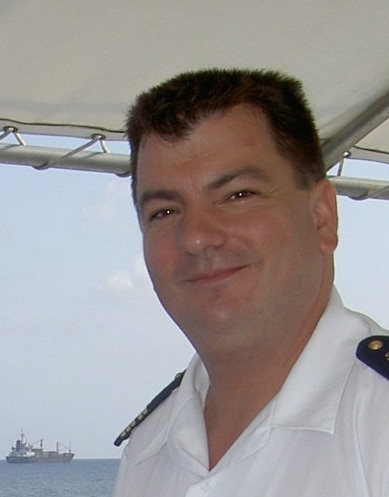
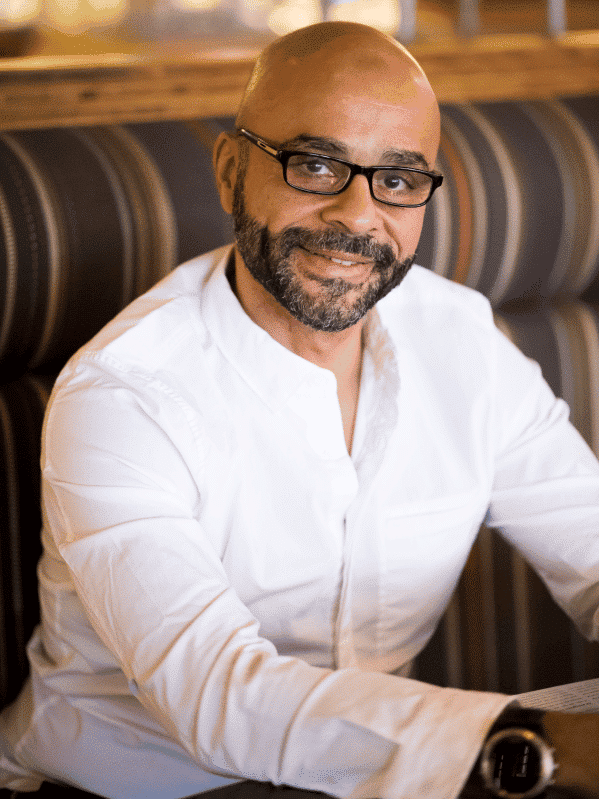
Lieutenant Colonel since 2010, Christophe HERVE has regularly served in American, British, and Canadian headquarters in the Atlantic, the Mediterranean, the Arabian-Persian Gulf, and Somalia during his assignments and detachments within the navy. During peace partnership exercises, he had the ...
Lieutenant Colonel since 2010, Christophe HERVE has regularly served in American, British, and Canadian headquarters in the Atlantic, the Mediterranean, the Arabian-Persian Gulf, and Somalia during his assignments and detachments within the navy. During peace partnership exercises, he had the opportunity to cooperate with the Romanian, Ukrainian, Greek, and Turkish navies. In 2009, he took on the role of communication officer for the Gendarmerie region of Pays de la Loire. In 2012, he was seconded to the maritime prefect of Brest in the State Action at Sea division. Lieutenant Colonel HERVE is a Knight of the National Order of Merit, a Knight of the National Order of Maritime Merit, holder of the bronze medal of national defense, and the French and WEU commemorative medals “Ex-Yugoslavia”.
Institutional and crisis communication: Qualified and then assigned as a communication officer for the Pays de Loire region for three years, he led a professional team in contact with national editorial offices (TV, radio, and print media). He managed the gendarmerie’s communication during major events such as coordinated rescue and police operations during Hurricane Xynthia, or during particularly sensitive judicial cases (Laëtitia Case, Dupont de Ligonnès Case, Marina Case, abduction and kidnapping of twins in Sarthe, among the most publicized). This role is often performed autonomously and requires constant risk-taking while maintaining an absolute trust link with the general management. Film editing and shooting reports in immersion with research units also allowed him to experience moments he considers privileged.
Leadership and management of a team in operational situations: Commanding three patrol boats in very different and sometimes complex theaters of operations allowed him to demonstrate a strong ability to gain adherence and ensure the smooth functioning of a unit composed of strong personalities, while allowing for the consideration and training of the younger or inexperienced through rewarding methods. He was also able to very favorably resolve numerous logistical and material issues thanks to a good understanding of the technical and scientific environment of a ship. (Organizing maintenance periods with Canadian shipyards, redesigning a defective engine exhaust system, for example)
Exercise of judicial police: During his assignments both in sailing units and in the company in Brest, he coordinated or personally led numerous judicial investigations related to areas such as: maritime fishing, financial and economic affairs (illegal fish trade, metal recovery in a department, public markets), labor law for seafarers, international drug trafficking, or maritime piracy. The last major case Christophe Hervé was able to handle as operations director led to the seizure and confiscation of a Honduran ship manned by Spaniards in the Indian Ocean, which was transferred and modified by the national navy, now known as “Le malin.” Ship value: 7 million Euros.
Exercise of Public Order Maintenance – Port Security – Negotiations: Regularly confronted with environmental organizations or socially very active fishermen, he has good experience in crisis-time negotiations. An emblematic case such as the Anna Knutsen, which occurred off Le Havre in June 2001, gave him the opportunity to successfully implement a negotiation on contact that led to the marine commandos team in charge of retaking the ship by force turning back. For 4 years, Christophe Hervé was in charge of port security at the military port of Brest, leading a team of 120 people spread over numerous geographical locations: 500 hectares of facilities including a 130-hectare military port and a 200-hectare shipyard arranged on a three-kilometer seafront. 70 ships, from tugs to frigates, are based there. 2500 civilians and military personnel access it, and 11000 vehicles circulate there.
Hosting and leading a conference: Assigned for a year in 1998 to the Naval Instruction Center of BREST, during the officers’ course (CDO) as director (Responsible for the training of Officers seconded to embassies for Interpretation/Translation, student pilot officers, and future ship commanders at sea), he experienced both the direction of a course and the conduct of training sessions either practical, in classrooms, or in an amphitheater. Similarly, a little later, after two years of experience leading his communication team, with his senior “OFF COM’s” colleagues regularly solicited by management to train newcomers, he discussed before a large audience (journalists, elected officials, business leaders) various sensitive cases and the original communication strategies implemented.
During my conferences, I particularly appreciated, beyond the academic nature of the exercise, the complicity of a professional, mature, reactive, and seasoned audience, provided one is legitimate on their subject. I thus propose, with pleasure, to renew these hosting experiences on topics that personally fascinate me.