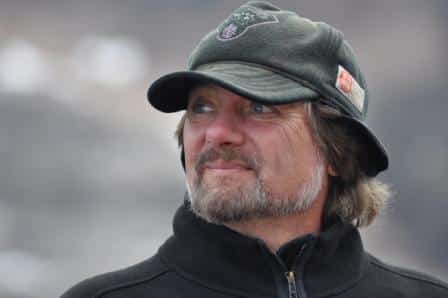
Arved Fuchs is the first person to reach both the North Pole and the South Pole on foot within a year. On May 13, 1989, he reached the Geographic North Pole with the ICEWALK expedition after 56 days and approximately 1000 km. In the same year, on December 30, he reached the South Pole on skis. At ...
Arved Fuchs is the first person to reach both the North Pole and the South Pole on foot within a year. On May 13, 1989, he reached the Geographic North Pole with the ICEWALK expedition after 56 days and approximately 1000 km. In the same year, on December 30, he reached the South Pole on skis. At the same time, he and the mountaineer Reinhold Messner completed the first full crossing of the Antarctic continent in 92 days. The distance was 2500 km in a straight line. These two expeditions also marked the end of the era of conventional navigation with sextants. The position determinations carried out by Arved Fuchs were largely conducted using astronomical location determination, as the GPS satellite system was not yet fully installed. Additionally, these expeditions were often cut off from the outside world, as there were no satellite phones at that time.
Arved Fuchs, together with Rainer Neuber, conducted the first and so far only winter circumnavigation of the legendary Cape Horn by kayak. On another expedition, he reached the Magnetic North Pole by kayak. Shortly thereafter, he undertook another kayak expedition to the ‘Cradle of Storms,’ as the Aleutian Islands are referred to by the indigenous people.
With his sailing ship “Dagmar Aaen,” Arved Fuchs completed the first complete circumnavigation of the North Pole – essentially the first world circumnavigation on the Arctic route. Fuchs has sailed the Northwest Passage once from east to west and another time from west to east. He has visited the Siberian Northeast Passage a total of four times and has also navigated its entire length. As the first Western expedition, Fuchs received permission in 1991, during the time of the Soviet Union, to visit the Franz Josef Land archipelago. He reached as far as 81° and discovered, among other things, the original document regarding the discovery of the archipelago from 1873. This document is now housed in the Maritime Museum of Bremerhaven. He has spent several winters with his expedition ship in pack ice.
Arved Fuchs has conducted several dog sledding expeditions in the Arctic: In 1983, he crossed the Greenland ice sheet along the 71st parallel in 70 days. In 2006, he traveled with traditional dog teams in the northern part of Canada’s Ellesmere Island.
In 1995, he and his team undertook the longest crossing of the “Southern Patagonian Ice Field” to date. During the 44-day ski expedition, seven first ascents were made, and the key point of the ice field, the ‘Failla de Reichert,’ was climbed for the first time.
In 2000, he, along with three companions, achieved the first complete repetition of the Shackleton Expedition in Antarctica. From the Antarctic Peninsula, the four friends sailed with a faithful replica of Shackleton’s lifeboat “James Caird” to Elephant Island and then on to South Georgia – a total distance of approximately 1800 kilometers. They also crossed the high mountains of South Georgia along the Shackleton route to the old whaling station Stromness.
In addition to his lecture series on his current expeditions and his talks on climate change, Arved Fuchs has developed a concept specifically aimed at companies: As one of Germany’s most experienced expedition travelers, Arved Fuchs knows what project planning, motivation, team spirit, or risk management means – terms that no employee-oriented company can overlook today. His lecture “Breaking Boundaries” provides employees or clients with insights into an unusual but successful way of working and living – vividly illustrated with exciting personal accounts and impressive images from expedition life. Because whether in a company or on board an expedition ship, the same questions arise in crisis situations: How does one deal with fear? What solutions are available? How can emotions be brought to a rational level? How can team spirit and motivation be maintained or even strengthened? What lessons can be learned from failed endeavors? Seemingly adventurous ideas often provide creative answers to these questions.
Arved Fuchs has written 16 books. Numerous television documentaries and articles in magazines such as “National Geographic,” “GEO,” and “Stern” have been published about his expeditions.