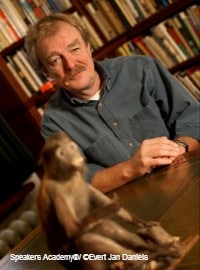
One biologist practices his profession with binoculars, another with test tubes. Midas Dekkers (1946) does it with a typewriter, microphone, or camera. His interest in animals blossomed during his studies in Amsterdam, while his interest in people was sparked in the family café. Most of the time, ...
One biologist practices his profession with binoculars, another with test tubes. Midas Dekkers (1946) does it with a typewriter, microphone, or camera. His interest in animals blossomed during his studies in Amsterdam, while his interest in people was sparked in the family café. Most of the time, Midas Dekkers writes about the intersections between the two. Because they are quite peculiar, there is more than one occasion to laugh about it. Before you know it, you’ve actually learned something. After his studies, he began writing short pieces about animals. He contributed to, among others, NRC Handelsblad, de Volkskrant, and the Vara-Gids.
For Vara, he created the TV programs ‘Midas’, ‘Gefundenes Fressen’ (about food), ‘Eerste druk’ (about books), and for VPRO the children’s broadcasts ‘Max laadvermogen’ and ‘Pootjes’.
Until 2007, Midas Dekkers voiced his column every Sunday morning in the VARA radio program ‘Vroege Vogels’. Of the collections that were published, ‘De Gnoe’ (1998) is the last. A great success was ‘Lief dier’ (1992), about the ultimate consequence of the love between humans and animals: bestiality. In ‘De Vergankelijkheid’ (1997), Midas Dekkers opposes the zeitgeist that glorifies everything young and scorns the old. His children’s books have been awarded the Zilveren Griffel and the Vlag en Wimpel multiple times and have been translated into Japanese and Basque.
Dekkers also enjoyed much success with ‘De Larf’ (2002), in which he refreshingly examines children. A child is not a small adult with various issues, but a completely unique being. In ‘De Larf’, Midas Dekkers compares ‘the young of humans’ with the young of insects.
In addition to three Zilveren Griffels and two Vlag en Wimpels, he was named Mercur Columnist of the Year 2002, won the Prins Bernhard Cultuurfonds Prize for Nature Conservation in 1994 together with the program ‘Vroege Vogels’, and the Eureka Science Prize 2003.
About his book ‘Het grote moment. Hoe dieren geboren worden’, which was awarded the Zilveren Griffel, the jury said the following: “Characteristic of Dekkers are the formulations that are not only witty but also clarify what is difficult to understand through original images. With that, we are not saying anything new: It has been established multiple times in previous awards. The jury has decided to repeat itself because this book deserves another Zilveren Griffel.”