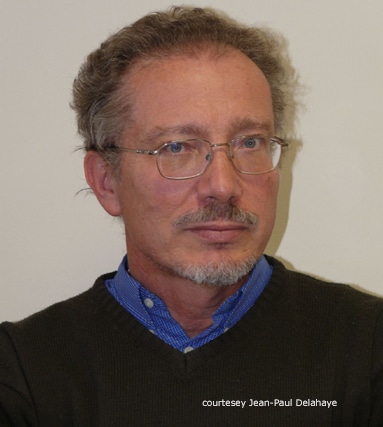
Jean-Paul Delahaye is a specialist in complexity theory. He is also a mathematician, computer scientist, and French writer.He earned his doctorate in mathematics in 1982 and initiated the design of complexity titled 'the computational design of games and information algorithmics.' He has worked on ...
Jean-Paul Delahaye is a specialist in complexity theory. He is also a mathematician, computer scientist, and French writer.
He earned his doctorate in mathematics in 1982 and initiated the design of complexity titled ‘the computational design of games and information algorithmics.’ He has worked on the computational theory of games since 1996 and on randomness since 2004. His previous research themes included the theory of transformations of sequences (from 1977 to 1982, concluded with his state thesis) and logic programming related to artificial intelligence (from 1982 to 1998).
Jean-Paul Delahaye has written works on computer science regarding the number (Pi) and prime numbers, notably: A Call for Vigilance Against Neo-Creationism and Spiritualist Intrusions in Science (2005), as well as mathematical articles such as ‘Logic and Computation’ for the journal Pour la Science and others for the Encyclopædia Universalis specialized in paper and DVD formats.
Today, Jean-Paul Delahaye is a professor of computer science at the University of Science and Technology of Lille and a researcher at the Lille Fundamental Computer Science Laboratory.
As a popularizer researcher, Jean-Paul Delahaye won the Prix d’Alembert from the Mathematical Society of France for The Fascinating Number Pi in 1998 and the First Prize for Scientific Culture from the Ministry of National Education, Research, and Technology in 1999.