
The government knows where you live. Tech companies know what you dream of.

Europe is negotiating the question of when you are recognisable. The question of who you are remains unaddressed.
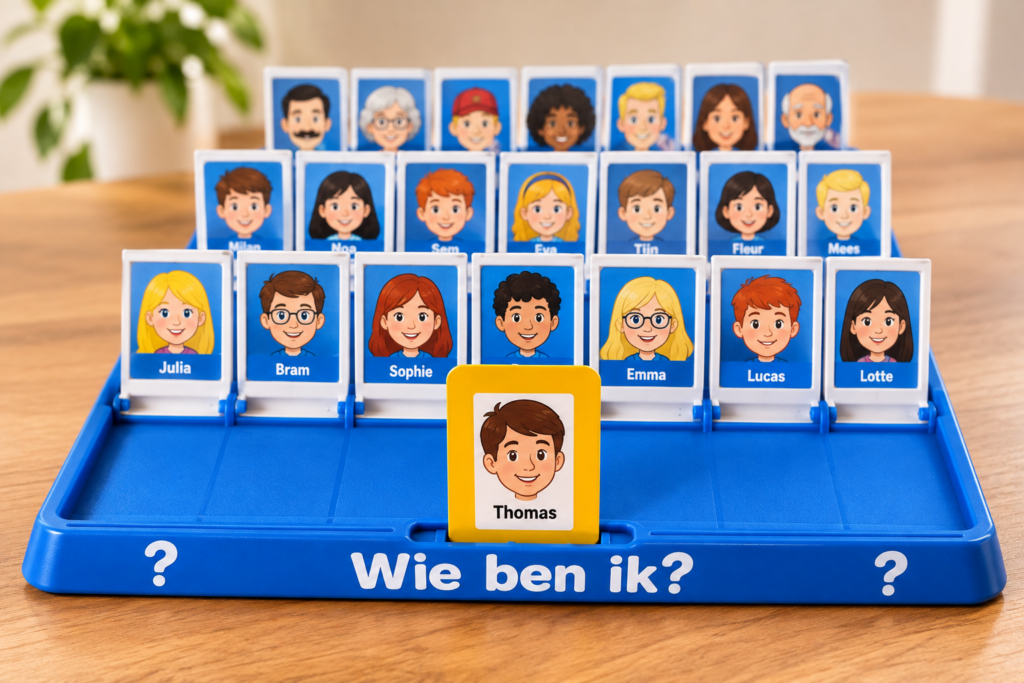
Who Am I?
Do you wear glasses? Do you have blonde hair? Brown eyes?
When you play the game Who Am I?, you engage in identification. Each question narrows down the group of candidates until only one person remains. For humans, this process is quite challenging, but computers are very good at it.
That a handful of characteristics is enough to identify someone was already evident in 2006, when a search engine released the anonymised search queries of hundreds of thousands of users. User 4417749 searched for ‘numb fingers’, ‘single men aged 60’ and ‘a dog that urinates everywhere’. Search terms proved so identifying that the anonymisation was easily circumvented. Journalists traced it back to Thelma Arnold in Lilburn, Georgia. But her search terms revealed much more than just her name and address: they unveiled a large part of her identity. “My goodness, this is my whole personal life,” Mrs Arnold told the journalists. “I had no idea someone was looking over my shoulder.”
Identification versus Identity
To understand what is happening here, we must separate identification from identity. The French philosopher Paul Ricoeur described this difference. Identification occurs based on what makes you recognisable: your name, face, hair colour. Your identity, on the other hand, relates to deeper values: what drives you, what you fear, what you stand for.
In other words: a name, address or social security number has little to do with identity. They function as keys that can link someone to systems. Privacy legislation is built around those keys: what is attached to an identifiable person is protected. But as Mrs Arnold experienced, the value of that key is minimal if the vault is already open.
Those Who Know the Most About Us Are the Least Supervised
We have opened that vault ourselves. Consciously or not, we share very personal information with companies, search engines and chatbots. LinkedIn knows your CV and has an accurate picture of your professional life. WhatsApp has a real-time view of your social network and with whom you communicate at any given time. Google can deduce where you sleep, where you work and which GP you visit, and your favourite chatbot can paint an eerily accurate picture of your identity. We signed up for this ourselves. With every click on ‘agree’, we gave permission under conditions that almost no one read.
This is information our government does not possess. Moreover, it is only allowed to link its own registers to a limited extent. After a series of scandals with government algorithms, this is very understandable. But companies are allowed to do what the government is not, because we ourselves give them permission. This creates a dangerous situation.
Tech companies know more about what we do, think and dream than our own government. Moreover, there is little to prevent them from making far-reaching analyses with it. Facebook, Cambridge Analytica and Target are examples you probably know. Recent research shows that a chatbot with personal information can change your mind in a debate more easily than a human. The bottom line is that an AI company can influence you, even if it does not know your name or where you live. It can steer you in what you buy, what you believe, who you trust and who you vote for.
Digital Omnibus
Europe is currently negotiating the so-called Digital Omnibus, a legislative proposal that, under the guise of ‘simplification’, amends several digital laws at once. One of the key points is the question of when data can be traced back to a person. The answer, as currently formulated, sounds like a tautology: for a party that cannot trace you, that data is not traceable. The debate thus revolves again around the key. And so you are stuck: If companies know your name, you have given permission yourself. If they do not, the law does not apply to them. In both cases, the vault is open.
A Law for the Vault
What we need is a different starting point. Legislation should not only consider whether someone is identifiable, but also what can be inferred from user data about identity, and what it is used for. A profile without a name is still a profile, and a click on ‘agree’ should not be a free pass. The AI regulation prohibits artificial intelligence that manipulates people, but only if demonstrable harm results. By then, the damage is already done. Therefore, companies should be transparent about the profiles they create and be accountable if they use them to steer us. Only then does the law protect the vault, not just the key.
The government does not need to know what we dream of. But it must protect us from companies that do.
Curious about more from Peter de Kock? Take a look at his profile!
A contribution of

From reading to listening?
The best stories truly come to life on stage. Our consultants will be happy to advise you personally.